FakeRean
Cuadro de Mando de Amenazas
Cuadro de mando de amenazas EnigmaSoft
EnigmaSoft Threat Scorecards son informes de evaluación de diferentes amenazas de malware que nuestro equipo de investigación ha recopilado y analizado. Los cuadros de mando de amenazas de EnigmaSoft evalúan y clasifican las amenazas utilizando varias métricas que incluyen factores de riesgo reales y potenciales, tendencias, frecuencia, prevalencia y persistencia. Los cuadros de mando de amenazas de EnigmaSoft se actualizan regularmente en función de nuestros datos y métricas de investigación y son útiles para una amplia gama de usuarios de computadoras, desde usuarios finales que buscan soluciones para eliminar malware de sus sistemas hasta expertos en seguridad que analizan amenazas.
EnigmaSoft Threat Scorecards muestra una variedad de información útil, que incluye:
Popularity Rank: The ranking of a particular threat in EnigmaSoft’s Threat Database.
Nivel de severidad: El nivel de severidad determinado de un objeto, representado numéricamente, basado en nuestro proceso de modelado de riesgo e investigación, como se explica en nuestros Criterios de evaluación de amenazas .
Computadoras infectadas: la cantidad de casos confirmados y sospechosos de una amenaza particular detectada en computadoras infectadas según lo informado por SpyHunter.
Consulte también Criterios de evaluación de amenazas .
| Popularity Rank: | 18,004 |
| Nivel de amenaza: | 100 % (Elevado) |
| Computadoras infectadas: | 9,842 |
| Visto por primera vez: | November 30, 2010 |
| Ultima vez visto: | January 29, 2026 |
| SO(s) afectados: | Windows |
El caballo de Troya FakeRean se incluye generalmente como archivo adjunto en correo electrónico, similar al ZBot, y así se propaga. Los mensajes basura logran difundir al FakeRean al incluir un archivo ejecutable llamado "install.exe" dentro de un fichero zip. Si el usuario descarga el fichero ZIP y ejecuta el archivo "Install.exe", su sistema se infectará con el caballo de Troya FakeRean. El FakeRean puede causar daños a los archivos del sistema de una computadora y es, en algunos casos, difícil de detectar y de eliminar manualmente. Se le conoce también como W32/FakeAV.AE!genr, W32/FakeRean.A.gen!Eldorado o TrojanDownloader:Win32/FakeRean….
Tabla de contenido
Alias
15 proveedores de seguridad marcaron este archivo como malicioso.
| Antivirus Vendor | Detección |
|---|---|
| AVG | Cryptic.EOS |
| Fortinet | W32/Jorik_Fraud.SRX!tr |
| Ikarus | Trojan.Win32.Loktrom |
| AntiVir | TR/Symmi.176421 |
| Kaspersky | Trojan.Win32.Jorik.Fraud.srx |
| AVG | Crypt.BXIV |
| Fortinet | W32/Generic!tr |
| McAfee | Fake-Rena-FMB!D3516C44B50F |
| AVG | Generic30.BBID |
| Kaspersky | Trojan-FakeAV.Win32.CProtection.aih |
| Symantec | Trojan.Winlock!gen1 |
| Fortinet | W32/Generic.GPL!tr |
| AntiVir | TR/Fake.Rean.776 |
| Sophos | Troj/FakeAV-GOU |
| McAfee | Fake-SecTool-FLM!B7B9041FC273 |
SpyHunter detecta y elimina FakeRean
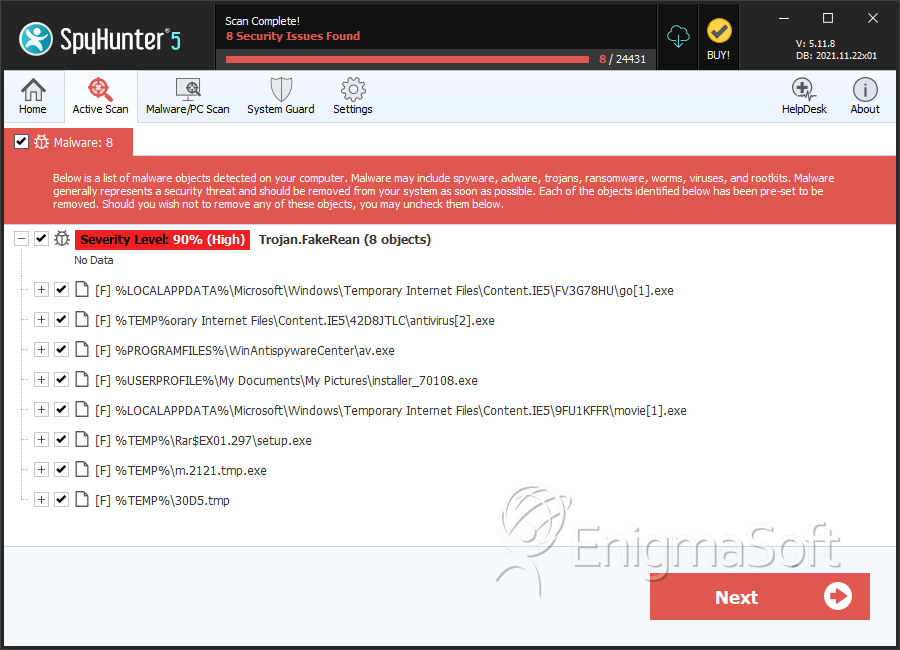
Detalles del Sistema de Archivos
| # | Nombre | MD5 |
Detecciones
Detecciones: la cantidad de casos confirmados y sospechosos de una amenaza particular detectada en computadoras infectadas según lo informado por SpyHunter.
|
|---|---|---|---|
| 1. | msecurity.exe | d35d56ba42a7b32196ff263fb79e3cad | 5 |
| 2. | security_cleaner.exe | 635515dd37ff62f238920eacaf91e233 | 4 |
| 3. | pnj.exe | ae7d35206e33efa128fed3ab03f25cd9 | 3 |
| 4. | nek.exe | 632d67b553428b93204f7457472f3972 | 3 |
| 5. | ndr.exe | c4f2c5841f26525a899a53b0c12d7bb3 | 2 |
| 6. | fmb.exe | 3c29d43a0f4f4803fd1fb1866bf46cbd | 2 |
| 7. | exr.exe | 70d574b7f24bd23467d2188377025039 | 2 |
| 8. | fap.exe | 20167cba152bdc52965a84b488d05627 | 2 |
| 9. | erv.exe | f61e2a0ad9d5e04ab1baca8399ecfd18 | 2 |
| 10. | pdh.exe | 82be0d41ee155bfcf919f8a5ded9c6d4 | 2 |
| 11. | wwe.exe | 7df15ed96ced549d4ddd5a388b8505e0 | 2 |
| 12. | av.exe | 0bc5e06b4fe42bbdde18b534ec8feb91 | 2 |
| 13. | tlf.exe | fd965a0be37382bc83ebfcb8a7ba3e52 | 2 |
| 14. | dow.exe | 9bd2bc135683525822d1c251d4959847 | 2 |
| 15. | drw.exe | 529b489bb3eb8232f87318b8bb3e3ba3 | 2 |
| 16. | bcq.exe | 8b8585f8d64dd6383dcf8dbbf49621be | 1 |
| 17. | qwu.exe | f0e50738e85f8db4787130b4823e1906 | 1 |
| 18. | aak.exe | 4da1e82ba52f7050757fa2104b14c87e | 1 |
| 19. | sve.exe | 61e91f6e0cd4b05e2701fdd4c048bd47 | 1 |
| 20. | jqq.exe | 8657d274e17a0936704365288e8d04f8 | 1 |
| 21. | qnb.exe | 802c064f0ba701e499dd0605e218a5e4 | 1 |
| 22. | bll.exe | f8b7849c7ac2b3c850332b78b2f0189f | 1 |
| 23. | ljo.exe | 4c33f7dfd6dc5f684e60f9e019e7c180 | 1 |
| 24. | snf.exe | 99569cebc1f721ff66217699808230bc | 1 |
| 25. | bvk.exe | 3958bb38562dee3cc0ae35d4220aa627 | 1 |
| 26. | yna.exe | 3f9ef3cef499dd435d7b86d74ea838bb | 1 |
| 27. | kfk.exe | 433f01b5642c37016588f11ee5485519 | 1 |
| 28. | 8814206.exe | 86562961e94a757cb37576d2a955c06b | 1 |
| 29. | amsecure.exe | d3516c44b50fabd3ba2636e54ff172d1 | 1 |
Reporte de análisis
Información general
| Family Name: | Rogue.FakeRean |
|---|---|
| Signature status: | No Signature |
Known Samples
Known Samples
This section lists other file samples believed to be associated with this family.|
MD5:
0604af7c52911b648819277aa11e2872
SHA1:
38b24c6e11a0e5a8d9dc7ef4dead9399d96543e7
SHA256:
B599512AF4A79C574D397B1F3AD319B5912FD86C00F3C57A2224EA6D540FD11F
Tamaño del archivo:
393.22 KB, 393216 bytes
|
|
MD5:
e3cb47ea02d2ff4cec014a3e4be1004e
SHA1:
f240b4ed11c4a0e44876ce1185ddfebf7e5df0f2
SHA256:
A41A998C482BA943BDCBE019AD9115C0D4BBA64D25CEF19B5377F99A437C2072
Tamaño del archivo:
2.79 MB, 2786304 bytes
|
|
MD5:
7684c3746b315e2ba8768771f8c88a0d
SHA1:
b558fd80a32aef34ad0d1f408bf9afca62016651
SHA256:
12A24B74AF1C7C3F73382B10EC08C1FB10A4ABFF049E9DB425EDFE47A295FB15
Tamaño del archivo:
1.82 MB, 1818624 bytes
|
Windows Portable Executable Attributes
- File doesn't have "Rich" header
- File doesn't have debug information
- File doesn't have exports table
- File doesn't have relocations information
- File doesn't have security information
- File has TLS information
- File is .NET application
- File is 32-bit executable
- File is either console or GUI application
- File is GUI application (IMAGE_SUBSYSTEM_WINDOWS_GUI)
Show More
- File is Native application (NOT .NET application)
- File is not packed
- IMAGE_FILE_DLL is not set inside PE header (Executable)
- IMAGE_FILE_EXECUTABLE_IMAGE is set inside PE header (Executable Image)
File Icons
File Icons
This section displays icon resources found within family samples. Malware often replicates icons commonly associated with legitimate software to mislead users into believing the malware is safe.


Windows PE Version Information
Windows PE Version Information
This section displays values and attributes that have been set in the Windows file version information data structure for samples within this family. To mislead users, malware actors often add fake version information mimicking legitimate software.| Nombre | Valor |
|---|---|
| Assembly Version | 1.0.0.0 |
| Comments | MBM Converter |
| Company Name |
|
| File Description |
|
| File Version |
|
| Internal Name |
|
| Legal Copyright | Copyright © Luxtron 2010 |
| Legal Trademarks | Cequenze Technoloy Inc. |
| Original Filename |
|
| Product Name |
|
| Product Version |
|
File Traits
- .NET
- vb6
- x86
Files Modified
Files Modified
This section lists files that were created, modified, moved and/or deleted by samples in this family. File system activity can provide valuable insight into how malware functions on the operating system.| File | Attributes |
|---|---|
| c:\windows\appcompat\programs\amcache.hve | Read Data,Read Control,Write Data |
| c:\windows\appcompat\programs\amcache.hve | Write Attributes |
Windows API Usage
Windows API Usage
This section lists Windows API calls that are used by the samples in this family. Windows API usage analysis is a valuable tool that can help identify malicious activity, such as keylogging, security privilege escalation, data encryption, data exfiltration, interference with antivirus software, and network request manipulation.| Category | API |
|---|---|
| Syscall Use |
Show More
|
| User Data Access |
|
| Anti Debug |
|
| Process Shell Execute |
|
| Encryption Used |
|
| Process Manipulation Evasion |
|
| Other Suspicious |
|
Shell Command Execution
Shell Command Execution
This section lists Windows shell commands that are run by the samples in this family. Windows Shell commands are often leveraged by malware for nefarious purposes and can be used to elevate security privileges, download and launch other malware, exploit vulnerabilities, collect and exfiltrate data, and hide malicious activity.
C:\Windows\Microsoft.NET\Framework64\v2.0.50727\\dw20.exe dw20.exe -x -s 824
|


