Not-a-virus.Keygen.CloneDVD
Cuadro de Mando de Amenazas
Cuadro de mando de amenazas EnigmaSoft
EnigmaSoft Threat Scorecards son informes de evaluación de diferentes amenazas de malware que nuestro equipo de investigación ha recopilado y analizado. Los cuadros de mando de amenazas de EnigmaSoft evalúan y clasifican las amenazas utilizando varias métricas que incluyen factores de riesgo reales y potenciales, tendencias, frecuencia, prevalencia y persistencia. Los cuadros de mando de amenazas de EnigmaSoft se actualizan regularmente en función de nuestros datos y métricas de investigación y son útiles para una amplia gama de usuarios de computadoras, desde usuarios finales que buscan soluciones para eliminar malware de sus sistemas hasta expertos en seguridad que analizan amenazas.
EnigmaSoft Threat Scorecards muestra una variedad de información útil, que incluye:
Popularity Rank: The ranking of a particular threat in EnigmaSoft’s Threat Database.
Nivel de severidad: El nivel de severidad determinado de un objeto, representado numéricamente, basado en nuestro proceso de modelado de riesgo e investigación, como se explica en nuestros Criterios de evaluación de amenazas .
Computadoras infectadas: la cantidad de casos confirmados y sospechosos de una amenaza particular detectada en computadoras infectadas según lo informado por SpyHunter.
Consulte también Criterios de evaluación de amenazas .
| Popularity Rank: | 15,896 |
| Nivel de amenaza: | 60 % (Medio) |
| Computadoras infectadas: | 1,330 |
| Visto por primera vez: | July 24, 2009 |
| Ultima vez visto: | June 11, 2026 |
| SO(s) afectados: | Windows |
El Not-a-virus.Keygen.CloneDVD es un gusano maligno que se propaga a través de redes existentes. El Not-a-virus.Keygen.CloneDVD puede descargar en el sistema otros archivos corruptos de Internet. El Not-a-virus.Keygen.CloneDVD también tiene la capacidad de enviar emails privados directamente a un servidor de correo con fines malignos. El Not-a-virus.Keygen.CloneDVD plantea un riesgo de seguridad importante y debe ser eliminado de inmediato.
Tabla de contenido
Alias
15 proveedores de seguridad marcaron este archivo como malicioso.
| Antivirus Vendor | Detección |
|---|---|
| AVG | Generic25.CJCV |
| Fortinet | W32/BDoor.CEP!tr.bdr |
| AhnLab-V3 | Trojan/Win32.ADH |
| AntiVir | BDS/Bifrose.A.394 |
| Kaspersky | Trojan.Win32.Midgare.bbsz |
| ClamAV | Trojan.Midgare-167 |
| CAT-QuickHeal | Trojan.Midgare.bbsz |
| Panda | Trj/Thed.M |
| AVG | Generic5_c.BUVP |
| TrendMicro | TROJ_SPNR.11I612 |
| F-Secure | Gen:Variant.Barys.1607 |
| eSafe | Win32.GenVariant.Kaz |
| McAfee | BackDoor-FACW!FEA05B1E642B |
| AVG | Generic5_c.AUMF |
| AhnLab-V3 | Backdoor/Win32.Buzy |
SpyHunter detecta y elimina Not-a-virus.Keygen.CloneDVD
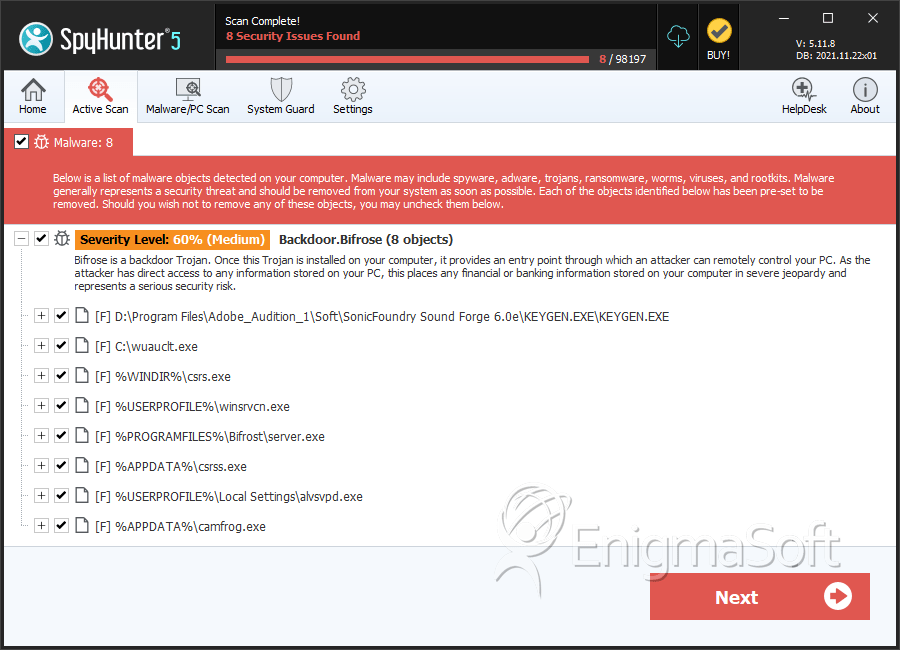
Detalles del Sistema de Archivos
| # | Nombre | MD5 |
Detecciones
Detecciones: la cantidad de casos confirmados y sospechosos de una amenaza particular detectada en computadoras infectadas según lo informado por SpyHunter.
|
|---|---|---|---|
| 1. | KEYGEN.EXE | c78823c750512ab280b62ec17ee2173a | 572 |
| 2. | wuauclt.exe | 2e2d0c602a60fba0ee1f3c68d2532237 | 76 |
| 3. | csrs.exe | a94dc5a0361bb54f4c40abf404441379 | 34 |
| 4. | update.exe | 4b63963bcc580f48f5a40bda656ebd51 | 6 |
| 5. | winsrvcn.exe | f75a8c506ed70d465e15065146843385 | 4 |
| 6. | server.exe | 1bf5e02e439c6cf09c220d5710b46ad5 | 4 |
| 7. | csrss.exe | b6c30f087bb3cbc38c7abb3e2ca4eaf2 | 2 |
| 8. | alvsvpd.exe | 61e2355a9bc4d852c06571b51f084448 | 2 |
| 9. | camfrog.exe | c8b0f1482d5026134d4be7f3b906b21f | 1 |
| 10. | system32.exe | e83b9b6a0f906ad6564afc890ea5c6bd | 1 |
| 11. | file[1].exe | 9b1b8011f18ac6b95c87cc5c115514e7 | 0 |
| 12. | ffx.exe | 905d88c67659fe04a35ec2c0f86c4ed0 | 0 |
| 13. | winsystem.exe | 4920b9bcc50cac48ce4cb3f4ce4c527e | 0 |
| 14. | svchost.exe | 624f45f8ef3f192e8eb09a529fe0e3fe | 0 |
| 15. | spoolsv.exe | c665a55e56966c44171d9c8900fbb529 | 0 |
| 16. | ccdrive32.exe | 39f2c3805d88cf76c5d79c54c1e37349 | 0 |
| 17. | rundll32.exe | 8d08b75195561ed02caa6f0abb3b4fd8 | 0 |
| 18. | msn.exe | 2afb4ee104bc1d0be383845845a9b511 | 0 |
| 19. | H2sfasH.exe | 31eb4ff720d93075a2fcbb203c590ff2 | 0 |
| 20. | msvmcls64.exe | ae7fa2384864f34947ac24f45ca9e4bf | 0 |
| 21. | win23.exe | f2e2909a1aa1ba25357768061979b621 | 0 |
| 22. | file.exe | d948009c57aa4ef2d0e1944b561c12ba | 0 |
Detalles del Registro
Reporte de análisis
Información general
| Family Name: | Backdoor.Bifrose |
|---|---|
| Signature status: | No Signature |
Known Samples
Known Samples
This section lists other file samples believed to be associated with this family.|
MD5:
8b6450f6d43a9e848f6d33b06b3411c3
SHA1:
1f677ad0abcfe8f0c4c694c7732c7f95a94d08f6
SHA256:
8150596BCBBE51058C6988D0278A1AB14DC14F02700639E771D420726A81BA9A
Tamaño del archivo:
3.17 MB, 3166208 bytes
|
|
MD5:
ba5de8b0ccd90eab0ab08ca8faa5b697
SHA1:
93ce801c072fa3cabe89cbe99fe335b4d62e3002
SHA256:
584A45DCA84D00B14EDD873BF269AE72A66044C13134E146951B16A5CCD12456
Tamaño del archivo:
5.02 MB, 5015040 bytes
|
|
MD5:
7986f0b718c0d7e95fdc2f491f033283
SHA1:
acbaa5c70d1d0c26eedd5138d1aad053cce4e9b4
SHA256:
13D1E31F1E8F94350AD2102D17D9522773B2EE1207C7B24FEC6128AFC866DAD7
Tamaño del archivo:
3.04 MB, 3036221 bytes
|
|
MD5:
bcef13ffd1d27cb525693f8b8c3d0826
SHA1:
b8eda99ca10e5cf3c48fd8c162c0790432c9d4d6
SHA256:
42C6210504AAEA0904188AE3A7AA5176891ACCD8CF548A97739A8B9DCEBC63D9
Tamaño del archivo:
3.25 MB, 3248128 bytes
|
Windows Portable Executable Attributes
- File doesn't have "Rich" header
- File doesn't have debug information
- File doesn't have relocations information
- File doesn't have security information
- File has exports table
- File has TLS information
- File is 32-bit executable
- File is either console or GUI application
- File is GUI application (IMAGE_SUBSYSTEM_WINDOWS_GUI)
- File is Native application (NOT .NET application)
Show More
- File is not packed
- IMAGE_FILE_DLL is not set inside PE header (Executable)
- IMAGE_FILE_EXECUTABLE_IMAGE is set inside PE header (Executable Image)
File Icons
File Icons
This section displays icon resources found within family samples. Malware often replicates icons commonly associated with legitimate software to mislead users into believing the malware is safe.

Windows PE Version Information
Windows PE Version Information
This section displays values and attributes that have been set in the Windows file version information data structure for samples within this family. To mislead users, malware actors often add fake version information mimicking legitimate software.| Nombre | Valor |
|---|---|
| Comments |
|
| Company Name |
|
| File Description |
|
| File Version |
|
| Internal Name | HTLaunch |
| Legal Copyright |
|
| Original Filename | HTLaunch.exe |
| Product Name |
|
| Product Version |
|
File Traits
- 00 section
- 2+ executable sections
- HighEntropy
- Inno
- InnoSetup Installer
- Installer Manifest
- Installer Version
- RT
- VirtualQueryEx
- x86
Block Information
Block Information
During analysis, EnigmaSoft breaks file samples into logical blocks for classification and comparison with other samples. Blocks can be used to generate malware detection rules and to group file samples into families based on shared source code, functionality and other distinguishing attributes and characteristics. This section lists a summary of this block data, as well as its classification by EnigmaSoft. A visual representation of the block data is also displayed, where available.| Total Blocks: | 5 |
|---|---|
| Potentially Malicious Blocks: | 0 |
| Whitelisted Blocks: | 3 |
| Unknown Blocks: | 2 |
Visual Map
? - Unknown Block
x - Potentially Malicious Block
Similar Families
Similar Families
This section lists other families that share similarities with this family, based on EnigmaSoft’s analysis. Many malware families are created from the same malware toolkits and use the same packing and encryption techniques but uniquely extend functionality. Similar families may also share source code, attributes, icons, subcomponents, compromised and/or invalid digital signatures, and network characteristics. Researchers leverage these similarities to rapidly and effectively triage file samples and extend malware detection rules.- BadJoke.LMG
- Banker.RF
- Casbaneiro.A
- Delf.GFA
- Filecoder.RR
Show More
- Injector.AK
- Installmonstr.EC
- Lumma.GFD
- MSIL.Agent.FG
- Rugmi.IA
- Sheloader.A
- Sheloader.C
- Stealer.KF
Windows API Usage
Windows API Usage
This section lists Windows API calls that are used by the samples in this family. Windows API usage analysis is a valuable tool that can help identify malicious activity, such as keylogging, security privilege escalation, data encryption, data exfiltration, interference with antivirus software, and network request manipulation.| Category | API |
|---|---|
| Other Suspicious |
|
| User Data Access |
|
| Anti Debug |
|


